
How to Get FREE Quality Backlinks: 12 Strategies in 2024
- John Carlo Cabatuan
- Oct 9, 2024
- 11 min read

What is Backlinks?

Also known as inbound links or incoming links, these are links from one website to another.
Backlinks are the backbone of SEO and continue to be one of the most influential ranking factors for search engines.
You probably already know how essential link building is for boosting your site's visibility in search engine results pages. But, despite the importance of backlinks, 94% of blog posts wind up without a single external link.
If you want to improve your website's ranking in search results, acquiring quality backlinks is essential.
But with SEO evolving and businesses constantly looking for new ways to build authority, it can sometimes feel like a challenge to get high-quality backlinks, especially without spending money.

Luckily, there are several effective strategies to earn backlinks for free. Here’s a comprehensive guide on how to get those precious backlinks in 2024.
But first,
Domain Authority = Backlinks?
All websites are given a domain authority score, which falls within a range of 1 to 100. Gaining an understanding of acquiring backlinks is crucial, but obtaining them from high-DA websites is even more advantageous.
Domain authority is a rating created by an SEO firm known as Moz. Domain authority shares many similarities with search engine rankings.
Indeed, domain authority is a metric utilized to assess the probability of a website appearing in search engine results, or SERPs.
Various kinds of backlinks can benefit SEO, however, the most desirable ones are those originating from websites with strong domain authority.
Obtaining backlinks from websites can boost your domain authority and search engine ranking, leading to increased leads.

Why Are Quality Backlinks Important?
Before diving into strategies, let's quickly review why backlinks are crucial. Backlinks are links from one website to another, and they signal to search engines that your content is valuable and trustworthy. The more high-quality backlinks you have, the better your site will perform in organic search rankings. Quality backlinks can:
Increase your site’s domain authority.
Drive referral traffic to your site.
Enhance your website’s visibility in search engine results.
What Makes a Quality Backlink?
Not all backlinks are created equal. You want backlinks that are:
From reputable, high-authority websites: A backlink from a high-authority site like Forbes is much more valuable than one from a low-quality site.
Relevant to your niche: Links from sites in your industry carry more weight.
Natural and earned: Google values backlinks that are earned through genuine content and relationship-building.
Now that you know the importance of backlinks and what makes a good one, let’s look at some practical ways to get them for free in 2024.
1. Guest Blogging with a Twist
Guest blogging remains one of the best ways to gain free backlinks. However, in 2024, it’s essential to do it differently. Rather than submitting generic guest posts to any site, focus on high-authority blogs within your niche. Research blogs that accept guest posts and are respected within your industry.

Start by:
Building relationships with blog owners.
Pitching unique, high-value content ideas.
Writing in-depth articles that provide real value to the readers.
Pro Tip: Include a few internal links to the host website’s previous articles to show that you’ve done your research. At the same time, you can organically weave a backlink to your own content, which will feel more natural and helpful.
2. Leverage HARO (Help A Reporter Out)
Help a Reporter Out (HARO) is a platform that connects journalists with sources who can give expert insights on relevant industry topics.
HARO is an excellent resource for earning backlinks for free. Reporters and journalists use
HARO to find expert opinions and quotes to include in their articles. By signing up for HARO, you can respond to queries related to your field of expertise. If a journalist uses your quote, they will often link back to your website.
So, how does HARO work exactly?
Journalists post requests for information from sources to include in an upcoming article.
You can register as a source to gain access to HARO requests and pitch your responses. If your response is up to scratch and covers what the journalist wants, your quote will be featured in their article.
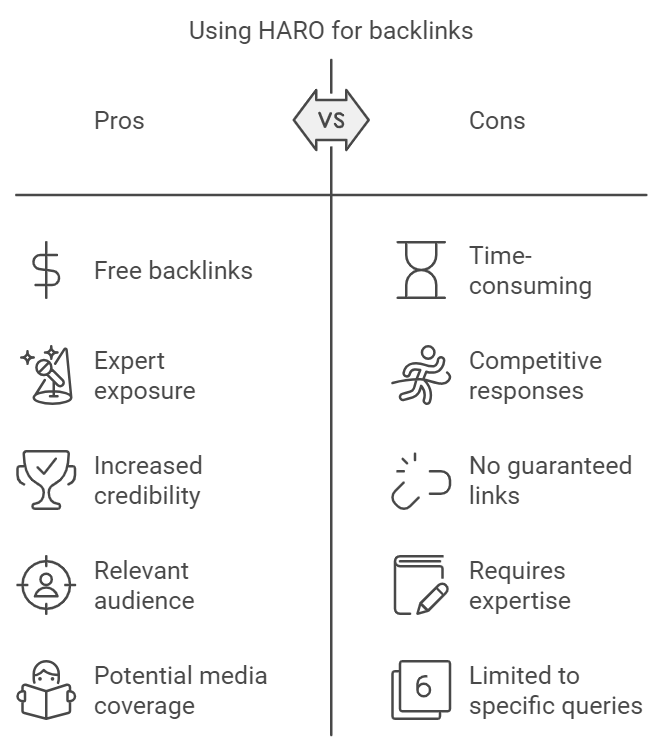
To get the most out of HARO:
First, you can opt for the traditional method. You will receive three HARO emails daily—around 5:35 a.m., 12:35 p.m., and 5:35 p.m. ET from Monday to Friday.
Second, you can use HARO’s new pitching platform, Connectively. This allows you to see journalist requests as they go live. Plus, you can filter opportunities and track your pitches within the platform.
Tips on using HARO for backlinks and PR
There are numerous HARO queries published each day, therefore you should only reply to those that match your relevant experience.
(experience is now a component of Google's E-E-A-T formula, by the way!).
For example,
Romz is seeking consumer analysts, so if you fit this description, have experience in research, or possess a related degree, you could be the ideal candidate.
On that note,
Make it clear right away that you are a quality and credible source for them.
State your credentials and relevant experience right away.
And don’t underestimate the power of your own credibility. You don’t have to be Elon Musk to get a link from The New York Times!
Writing compelling and informative responses is critical to getting published. Follow these tips for crafting strong HARO responses:

Provide data and statistics – Include researched numbers, stats, facts, and figures to make your response stand out. Data brings great value to reporters.
Share insider expertise and insights – Offer advice, tips, and knowledge on the topic as an industry expert. Provide unique perspectives.
Use examples and anecdotes – Bring your response to life by including real-world examples, case studies, anecdotes, and stories.
Add quotes – Quote yourself or colleagues to showcase first-hand experiences related to the topic.
Include links strategically – Link to high-quality resources on your site, like data reports, in-depth guides, and more. Do not over-optimize so it doesn’t look like you’re only helping to get high-quality links.
Keep it short – HARO recommends 2-3 concise paragraphs or 3-5 bullet points in most cases.
Focus on quality over quantity – It’s better to spend time making sure you have high-quality responses than trying to respond to as many queries as you can with sub-par quality.
By responding to relevant media queries in your niche, you can secure editorial links that will boost your SEO rankings.
It’s also ideal to optimize your efforts over time so you can invest in the strategies that work for you. Along with other link-building tactics, incorporate HARO as a key component of your overall strategy.
3. Create Skyscraper Content
Skyscrapers are known to be long-form pieces that range between 1,200 and beyond.

A skyscraper focuses on a relevant search keyword or hot subject, providing in-depth material that drives traffic, shares, and backlinks.
You can build engaging and in-depth content pieces such as:
Blogs
Whitepapers
eBooks
Help articles
The skyscraper technique involves finding existing high-ranking content, creating something better, and reaching out to the sites that linked to the original content.
Identify content that has plenty of backlinks (you can use SEO tools like Ahrefs or SEMrush for this).
Create a new piece of content that’s more comprehensive, up-to-date, and visually appealing.
Reach out to the website owners linking to the original content and show them how your content provides even more value.

The goal of SEO skyscraper construction is to be larger, better, newer, more engaging, and more relevant than the other websites on your topic.
Skyscrapers are seen as long-form content pieces that range from 1,500 words and beyond. This content marketing strategy helps you generate backlinks and identify better opportunities for conversions.
It is important to identify content that can become a part of this skyscraper content marketing strategy.
You should also analyze your existing content and identify skyscraper content marketing opportunities. All you have to do is understand which sections can be improved with graphics, studies, and more content.
As you update your content, your next step is to track its performance using the right tools and recognize backlinks that bring more business.
4. Use Infographics
Infographics merge information with visual elements, making complicated data easy to understand in a visually appealing way.
They can be easily shared on social media, blogs, and websites, which boosts the opportunity for backlinks.

However, due to their high popularity, it can be extremely challenging for an infographic to distinguish itself on the internet. Developing a visually appealing infographic that can generate backlinks necessitates thorough research and expert design skills.
To use infographics for free backlinks:
Research trending topics in your niche.
Create an infographic with compelling, easy-to-understand data.
Promote the infographic on social media and reach out to bloggers and influencers who may be interested in sharing it.
Make sure you include an embed code that links back to your website so when others share your infographic, they also link back to your content.
5. Broken Link Building

Broken link building is a tactic that involves finding resources in your niche that are no longer live, recreating a version of the content, and reaching out to webmasters who link to that content asking them to replace the broken link with a link to your newly created resource.
You’re providing value to the webmaster, helping them clean up their website and the web in general, while also building links to your website.
Broken link building is a tried-and-true method for getting quality backlinks for free. It involves finding broken links on other websites and offering your content as a replacement.
Here’s how to do it:
Use a tool like Check My Links or Ahrefs to find broken links on websites in your niche.
You can use Ahrefs’ free backlink checker for this, but life is much easier with full access to Ahrefs.
Keep this in mind as we go through the tactics below. You’ll need Ahrefs for ¾ of them.
Here are the tactics:
Look for your competitors’ broken pages with backlinks
Look for broken pages about a topic
Look for broken links on competing websites
Look for broken links on resource pages (doable without paid Ahrefs)
Reach out to the website owner or webmaster, informing them of the broken link and offering your content as a replacement.
Be polite and helpful in your outreach. Many website owners appreciate the heads-up and are happy to replace a broken link with your content if it fits.
Look for broken links on competing websites
Most websites frequently link to pages on other sites, and some of these will break over time.
That means your competitors are likely to link to broken pages.
Here’s how to see broken pages your competitor is linking to:
Go to Site Explorer
Enter a competing domain
Go to the Broken Links report

6. Publish Original Research or Case Studies
Original research or case studies are incredibly valuable to readers and other websites. When you publish a detailed study with unique data, many websites will link back to your study as a source, earning you free backlinks.

For example, you could:
Conduct a survey in your industry.
Analyze trends and publish your findings.
Use real-life data from your business and share how you achieved certain results.
The key is to make your research valuable and widely applicable so other sites will want to cite it.
7. Get Listed in Resource Pages and Directories
Link building for resource pages involves creating backlinks from pages with curated lists of links to external websites (resource pages).
Resource page link building works because it's a win-win for both parties involved.
Website owners are interested in enhancing their websites with valuable resources, therefore they are willing to include links to related content.

This method also assists in obtaining valuable links from respected sources in your field, enhancing your website's credibility with search engines.
Many websites have resource pages that link to tools, blogs, or websites within their niche. These resource pages can provide you with high-quality, free backlinks if you position yourself as an authority in your field.
Here’s how:
Finding Relevant Resource Pages
Using keywords related to your content along with search operators like "intitle:resources" or "inurl:resources.html" can help narrow down your results to pages likely to contain curated lists of resources.

Here are a few more keywords that can turn up useful results:
Keyword inurl:resources
Keyword “best resources”
Keyword” useful resources”
Keyword intitle:links
Keyword “helpful links”
Reaching Out and Suggesting Your Resource
It is crucial to tactfully and thoughtfully approach the process when recommending your resource. Create customized outreach messages that emphasize the importance of your resource for the recipient's audience.
You must be able to clearly explain why your resource would be a valuable addition to their page and how it aligns with their content goals. Individuals are seeking to understand the benefits for themselves.

8. Build Relationships and Collaborate
Link building is all about relationships between people who build links to deliver value to other people while also improving their websites’ performance.
So, only by prioritizing relationship building for backlinks can you strengthen your backlink profile.
Networking and building relationships within your industry are powerful ways to earn backlinks.
By connecting with influencers, bloggers, and business owners in your niche, you open the door to natural backlink opportunities.
The process involves defining your target audience and expectations, identifying potential link partners with aligned interests and good domain authority, and fostering relationships through meaningful interaction. Strategic and personalized outreach for link requests completes the cycle.
To build relationships:
Engage with industry leaders on social media.
Attend virtual conferences and webinars.

Personalize your outreach as much as possible.
Don’t stop engaging and interacting
Offer to collaborate on content or projects that could lead to backlink opportunities.
The key is to build authentic, mutually beneficial relationships, rather than simply asking for links.
9. Repurpose and Update Old Content
Repurposing old content into new formats can help you earn free backlinks. If you have a popular blog post, consider turning it into a video, podcast, or infographic.
These new formats are more shareable and can attract backlinks from different types of websites.
Additionally, updating old content with new data, trends, or insights makes it more likely to be referenced by others. If you already have backlinks to a piece of content, updating it can also help you retain those links over time.
10. Reach Out for Unlinked Brand Mentions
Sometimes, websites will mention your brand without linking back to your website. You can reclaim these unlinked mentions by reaching out to the website owner and politely requesting that they add a link.
To find unlinked mentions:
Use a tool like BuzzSumo or Ahrefs to track mentions of your brand.
Reach out to the website owner or editor and kindly ask for a link to your website.
This strategy works well when you’ve already built a relationship with the website or when the mention is positive.
11. Participate in Industry Forums and Communities
While forums don’t usually allow direct link-building, being active in online communities related to your industry can help you earn free backlinks over time. By sharing valuable insights, answering questions, and engaging with the community, you establish yourself as an expert.
Many times, bloggers or other website owners in the same industry will notice your contributions and link to your site when it’s relevant.
Just be careful not to spam forums with your links—focus on providing value first.
Consider online forums as virtual neighborhoods. There are communities for just about everything, from photography enthusiasts to dog lovers to (you guessed it) SEO professionals. The key is finding forums relevant to your niche or industry.

Search Engine Savvy: Start by searching for forums related to your business. Use keywords like “[your industry] forum” or “[your niche] online community” in your favorite search engine.
Lurk and Learn: Once you find some potential forums, spend some time browsing anonymously. This helps you understand the community engagement culture, the types of discussions happening, and the level of activity. Are there regular discussions? Is the community welcoming to newcomers?
Quality Over Quantity: Good community building for SEO is important. So, focus on finding high-quality forums with active discussions relevant to your target audience. Look for forums with a good mix of newbies and experienced users, as this allows you to both learn and contribute.
12. Create Linkable Assets
Creating valuable resources like comprehensive guides, infographics, videos, or tools encourages other websites to link to your content. These are called “linkable assets,” as they provide immense value to readers and are naturally shareable.
For example, a detailed industry report or a “how-to” guide that answers common questions can attract backlinks from multiple websites. By focusing on solving problems or answering specific queries, you can create evergreen content that naturally attracts quality backlinks over time.
Developing linkable assets goes beyond conducting keyword research and crafting well-designed graphics. Creating content that earns links organically means making something truly exceptional—content so compelling that others naturally want to link to it.
6 Types of Linkable Assets You Can Create
Creating the right types of linkable assets is key to driving backlinks and improving your site’s SEO. Different formats appeal to different audiences, and knowing what works best can boost your content marketing for backlinks.

Earning Free Backlinks in 2024
Getting quality backlinks for free in 2024 requires creativity, persistence, and a focus on creating value. Whether you’re building relationships with influencers, creating content that stands out, or using tools like HARO, the key is to focus on earning backlinks naturally.
Each of these strategies can help you improve your website's authority and ranking without breaking the bank.
By implementing these strategies,
You’ll be well on your way to building a solid backlink profile that improves your SEO efforts and helps your website stand out in an increasingly competitive digital landscape.


Comments